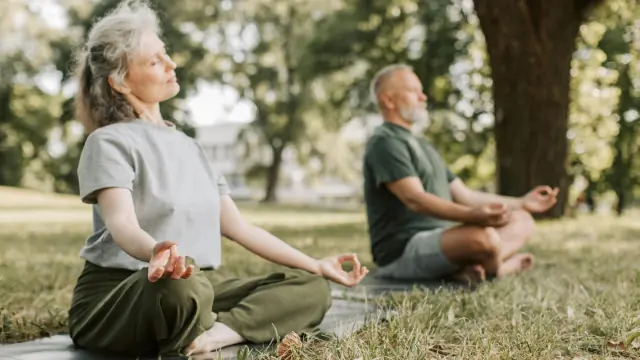
Practicing Yoga With Your Partner: What Works and What Doesn’t
Couples yoga can strengthen your relationship or turn into a frustrating mess, depending on how you approach it.
Lees meer…

Remember when you first started making real progress? When poses that seemed impossible suddenly clicked? When you could finally touch your toes or hold tree pose without wobbling? That feeling of improvement is addictive and energizing. It’s what keeps you coming back to the mat. But then something shifts. The progress slows down or stops entirely. Suddenly you’re stuck, and that momentum you had just evaporates. This plateau phase catches everyone off guard, but it’s not the end of your progress. It’s just a different phase that requires a different approach.
Plateaus aren’t signs of failure. They’re how adaptation works. Your body makes rapid initial progress, then needs time to consolidate those gains before the next jump. Think of it like climbing stairs instead of a ramp. You go up, then there’s a flat section, then up again. The flat sections feel frustrating because you’re not seeing change, but they’re necessary. Your nervous system is integrating what you’ve learned.
Comparing yourself to others is poison, but everyone does it anyway. The person next to you in class who can do splits effortlessly might have hypermobile joints. Or they danced for ten years. Or they’ve been practicing daily for five years while you practice twice a week. You’re seeing a snapshot of their current ability without any context about how they got there. It’s useless information that just makes you feel bad.
Some days you’ll be inexplicably worse at poses you could do yesterday. Your body isn’t consistent. Sleep quality, hydration, stress levels, hormone fluctuations, what you ate, all of it affects your performance. A bad practice doesn’t mean you’re regressing. It means you’re human. Stop treating every session like a performance evaluation.
When motivation disappears, lower the bar drastically. Can’t face an hour practice? Do ten minutes. Can’t do ten minutes? Do five. Can’t even do five? Just sit on your mat and breathe for two minutes. The goal is maintaining contact with the practice, not meeting some arbitrary standard. Momentum is easier to maintain than to rebuild from zero.
Frustration often comes from unrealistic expectations about timelines. You want to do crow pose, you practice for three weeks, you still can’t do it, you get frustrated. But crow pose might take six months or a year depending on where you’re starting from. The frustration isn’t about your progress. It’s about your timeline being wrong.
Change your metrics. Stop measuring progress by whether you can do specific poses. Track whether you’re more consistent than last month. Whether your breath control has improved. Whether you’re sleeping better. Whether your back hurts less. Progress shows up in many ways that have nothing to do with flashy poses.
Take breaks when you need them. A week off won’t destroy your practice. Sometimes stepping away gives your body recovery time and your mind perspective. You come back fresher and often find that things click more easily after a rest. Grinding through burnout just to maintain a streak is counterproductive.
The practice isn’t supposed to feel good all the time. It’s supposed to teach you something. Sometimes what it teaches is patience, or humility, or how to keep showing up when results aren’t visible. Those lessons matter as much as the breakthrough moments. Stay consistent through the plateau, and that next wave of progress will come. It always does.
Couples yoga can strengthen your relationship or turn into a frustrating mess, depending on how you approach it.

You don’t need an hour every day at the same time to build a real practice, you just need to be smarter about how you approach it.

There’s a reason ancient yogis practiced at sunrise on an empty stomach, and it has nothing to do with tradition for tradition’s sake.